


Pilates During Menopause? A Different Strategy for a Changing Body

Updated: Aug 27

Menopause is not a single symptom or a single moment. It is a transition that may influence how a woman sleeps, recovers, moves, builds strength and experiences her body.
Technically, menopause is reached after 12 consecutive months without a menstrual period. The years leading up to it are known as perimenopause, and the years afterward as postmenopause. Although every experience is different, this transition can be accompanied by changes in muscle strength, bone density, balance, joint comfort, energy, sleep, mood and cardiovascular health. The World Health Organization emphasizes that menopause can affect physical, emotional, mental and social well-being.
Movement can play an important role during this stage—but choosing the right kind of movement is not always as simple as being told to “lift heavier.”

Pilates or weightlifting?
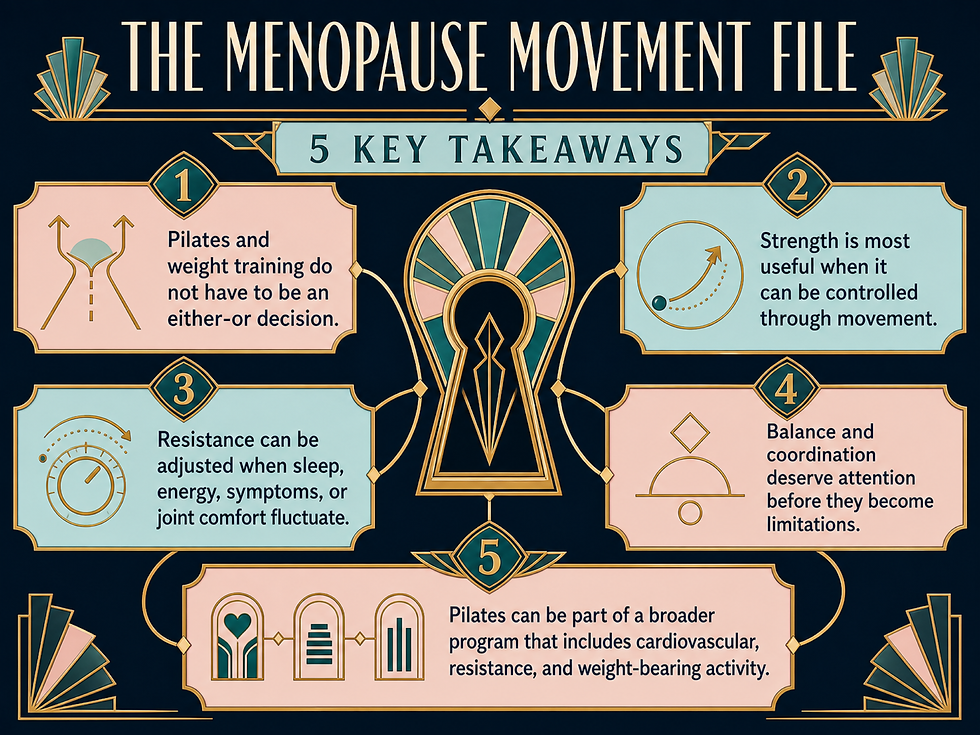
This does not have to be an either-or decision.
Progressive resistance training is important during and after menopause. It helps preserve muscle, builds strength and provides the mechanical loading bones need. Weight-bearing exercise is also an important part of supporting bone health. Both ACOG and the NHS recommend strength, resistance and weight-bearing exercise during this stage of life.
Pilates offers something different: a way to develop strength while also addressing mobility, balance, coordination, posture, breathing and movement quality.
For someone experiencing joint discomfort, disrupted sleep, inconsistent energy, balance changes, previous injuries or uncertainty about returning to exercise, that combination can make Pilates an especially useful place to begin.

Pilates is more than stretching
Pilates is sometimes described as a gentle flexibility practice. While it can certainly improve mobility, a well-designed Pilates program is also a form of resistance training.
On equipment such as the Reformer, Tower and Pilates Chair, springs provide adjustable resistance. Exercises can be progressed by changing the spring tension, body position, range of motion, stability challenge or complexity of the movement.
This allows the work to be appropriately challenging without requiring every person to begin with a barbell, heavy dumbbells or a crowded gym.
The goal is not simply to complete an exercise. It is to develop the control and strength needed to move more confidently outside the studio.

Why someone might choose Pilates during menopause
1. Strength and mobility are developed together
A changing body may need more than strength in one fixed position. It may need strength that can be used while reaching, rotating, bending, climbing stairs or getting up from the floor.
Pilates develops strength through controlled ranges of motion. This can help the body remain both capable and adaptable rather than becoming stronger but increasingly stiff.
2. The resistance is highly adjustable
Menopause symptoms do not necessarily appear on a predictable schedule. Sleep, energy and joint comfort may feel different from one week—or one day—to the next.
Pilates equipment allows resistance, support and range of motion to be adjusted without abandoning the purpose of the exercise. A session can meet the body where it is while still providing an appropriate challenge.
Adaptation does not mean avoiding effort. It means selecting the kind of effort the body can use well that day.

3. Balance and coordination are part of the work
Balance is not a separate skill that should be addressed only after it becomes a problem. It depends on strength, sensory awareness, reaction time and the ability to organize the body as conditions change.
Pilates regularly asks the body to stabilize, shift weight and coordinate multiple areas at once. These challenges can support balance, posture and movement confidence. ACOG notes that Pilates can help improve balance and posture, which are relevant to reducing fall risk.
4. Pilates teaches pressure and breathing strategies
Many strength exercises become more effective when a person understands how to breathe, organize the trunk and manage pressure through the abdomen and pelvic floor.
Pilates provides opportunities to practice these skills before the resistance becomes overwhelming. This can be particularly helpful for someone who braces excessively, holds her breath or feels pressure or instability during exercise.
5. It can provide a more approachable entry into strength work
Someone may understand that strength training is important and still feel unsure about beginning.
Perhaps she has never lifted weights. Perhaps a previous injury has affected her confidence. Perhaps she is uncomfortable in a traditional gym or does not know which exercises are appropriate.
Pilates offers a structured and supported environment in which strength can be developed gradually. As control and confidence improve, other forms of resistance training may become more accessible as well.
6. The exercises can be connected to everyday life
Pilates is valuable because the body that becomes better at performing Pilates exercises improves what the body can do elsewhere.
Depending on the individual, that might mean:
Getting up from the floor more easily
Carrying groceries with greater confidence
Climbing stairs with less effort
Improving posture and back comfort
Maintaining balance on uneven ground
Returning to a favorite sport or activity
Feeling more capable in daily life

A well-rounded menopause movement plan may include resistance training, weight-bearing activity, cardiovascular exercise, balance and coordination, mobility, and recovery. Pilates can support several parts of this broader picture.
Can Pilates provide a complete exercise program?
Pilates can address more of the menopause exercise picture than many people realize.
A thoughtfully designed Pilates program may include:
Progressive resistance training: Resistance can be increased through heavier springs, more challenging leverage, reduced assistance, unilateral work, longer time under tension and greater movement complexity. Progression should be planned rather than assumed.
Weight-bearing exercise: Standing Reformer work, Pilates Chair exercises, planks, quadruped positions and supported standing sequences require the body to accept and control weight through the arms, legs and spine. Appropriate loading may be especially important when supporting bone health.
Aerobic exercise: Pilates is not traditionally classified as cardiovascular training, but sustained sequences, Jumpboard work and carefully programmed circuits can raise the heart rate and challenge endurance. The aerobic effect will depend on the individual and the intensity and duration of the session.
Balance and coordination training: Standing, kneeling and unilateral exercises develop stability, reaction, body awareness and movement confidence.
Mobility and movement quality: Pilates develops usable mobility—the ability to control the body through its available range—rather than focusing only on passive flexibility.
Recovery: Lower-intensity Pilates sessions can support circulation, breathing, mobility and a gradual return to movement between more demanding workouts. Pilates may be used as active recovery without becoming passive or unproductive.
Pilates can be an important part—and, for some people, the foundation—of a comprehensive movement program during menopause. Depending on individual goals, health history and current activity, additional cardiovascular exercise, impact, weight-bearing activity or heavier resistance training may also be appropriate.
The key is not the exercise label. It is whether the program provides the appropriate amount of resistance, impact, weight-bearing activity, cardiovascular demand and recovery for that particular person.
A more intelligent way to move through menopause
Menopause does not mean the body has become fragile. It may mean the body is asking for a more thoughtful approach to challenge, recovery and progression.
Pilates can provide that approach.
It offers resistance without sacrificing movement quality, support without removing challenge and precision without requiring perfection. It can help someone understand what her body needs now—and build the confidence to keep progressing.
Through purposeful programming, Pilates can build strength, introduce progressive resistance, provide weight-bearing challenges, develop balance, raise the heart rate and support recovery. It can also be adapted when sleep, energy, symptoms or joint comfort fluctuate.
The best program is the one that provides enough challenge to create change, enough support to build confidence and a reason to keep showing up.
In this series, we will explore how Pilates can support the major movement-related concerns associated with menopause, including muscle loss, bone health, balance, joint stiffness, back comfort, sleep, fatigue, stress and cardiovascular well-being.
Trusted Resources
Want a broader overview of menopause, common changes, and available support? Visit the World Health Organization’s Menopause Fact Sheet.
READY TO FIND YOUR NEXT STEP?
Your body may be changing, but that does not mean it has become fragile. The right movement strategy can help you build strength, confidence and capability for what comes next.
Pilates Speakeasy offers thoughtful, adaptable movement experiences designed to meet you where you are—and help you keep progressing.
This article is for educational purposes and is not a substitute for individualized medical advice. New or concerning symptoms should be discussed with an appropriate healthcare professional.
Comments