


Bone Density During Menopause

Building Stronger Bones Through Load, Strength and Balance

Bone is a living tissue
Bone is living tissue. It is continually being broken down and rebuilt. During the menopause transition, falling estrogen levels can accelerate bone loss, making the years around the final menstrual period an important time to think deliberately about strength, loading and fall prevention.
This does not mean the body has suddenly become fragile. It means bone—like muscle—needs an appropriate reason to adapt. Movement can provide that reason when the challenge is specific enough, progressed thoughtfully and matched to the individual.
Why bone density changes
Estrogen helps regulate the normal cycle of bone remodeling. As estrogen declines, bone breakdown may outpace bone formation. The result can be lower bone mineral density and, for some women, osteopenia or osteoporosis—conditions that increase fracture risk.
Risk is not determined by menopause alone. Family history, early menopause, low body weight, smoking, alcohol use, nutrition, certain medications, medical conditions, previous fractures and physical activity all matter. A clinician may recommend a bone-density scan based on age and individual risk factors.

What kind of movement supports bone?
A bone-supportive program usually combines several movement qualities rather than relying on one exercise label.
Progressive resistance training
Muscles pull on bones as they produce force. Exercises such as squats, hinges, rows, presses, carries and step-ups can create useful loading when resistance gradually increases. The appropriate starting point may be body weight, springs, bands, dumbbells, machines or barbells—but progression is what turns activity into training.
Weight-bearing movement
Standing activities ask the skeleton to support the body against gravity. Walking, stairs, dancing, hiking and many standing Pilates exercises contribute weight-bearing activity, although the size of the bone stimulus varies.
Impact—when appropriate
When the feet meet the ground during walking, running, hopping or jumping, the skeleton experiences a rapid mechanical load. Bone tissue deforms by a tiny, normal amount—called strain. Bone cells sense that strain and help coordinate remodeling. Over time, an appropriately dosed and repeated training signal can encourage bone to become better prepared for similar demands.
The size, speed, direction and novelty of the load all matter. This is why impact is not interchangeable with simply moving faster or becoming tired. Research in postmenopausal women supports combining impact with progressive resistance and other weight-bearing activity rather than treating jumping as a stand-alone solution.
Small hops, jumps, jogging and dancing may provide useful impact when they are appropriate for the individual. More is not automatically better. People with osteoporosis, a history of fragility fracture, significant pain, pelvic-floor symptoms, poor balance or uncertainty about safety should seek individualized guidance before beginning or progressing impact.

Pilates Jumping (jumpboard)
Jumpboard work can be a valuable Pilates tool. Lying on the Reformer, the participant pushes away from a padded board, travels with the carriage and returns to a controlled landing against spring resistance. This creates supported, plyometric-style loading and can develop rapid muscle force, leg power, coordination, cardiovascular capacity and confidence with takeoff and landing.
The push against the springs creates meaningful muscular force through the feet, legs and hips. Each return to the board asks the body to organize a precise, controlled landing. Together, the push-off and rebound train the rapid force production, lower-body strength, coordination and landing control that support confident movement during menopause and beyond.
Jumpboard is best understood as controlled, supported plyometric training. The Reformer changes the direction and delivery of the load, allowing an instructor to adjust spring tension, range, tempo and landing mechanics. For an appropriate participant, it can be a practical bridge toward greater power, faster muscle response and confidence with impact-style movement. Upright weight-bearing and impact can also be included when they suit the individual’s goals, bone health and movement history.
Standing Pilates changes the demand
Moving an exercise from lying or seated to standing introduces body weight and gravity. Standing Reformer work, supported squats, lunges, step-ups, heel drops and balance challenges can increase loading through the feet, legs and hips while preserving the adjustable support that makes Pilates approachable.
Bone-focused Pilates protocols
Specialized programs—including branded approaches such as Buff Bones®—combine Pilates principles with progressive resistance, upright loading, balance, stamping or other site-specific challenges. The important feature is not the program name; it is whether the exercise supplies an appropriate, progressive stimulus while accounting for bone density, fracture history, spinal precautions and individual capability.
Balance and fall prevention
Bone strength matters, but preventing a fall matters too. Leg strength, balance, coordination, vision, reaction time, footwear, medications and the home environment all influence fall risk.
What the Pilates research shows
Clinical research offers encouraging support for structured Pilates during and after menopause. Two randomized trials reported improvements in bone mineral density after Pilates programs. One study in women with postmenopausal osteoporosis found increased lumbar BMD in the Pilates group while sedentary controls declined. A six-month trial also reported improvements at the lumbar spine and trochanter—the upper part of the femur near the hip.
Taken together, these findings suggest that well-designed Pilates can contribute to a bone-supportive program, particularly when it includes progressive resistance and weight-bearing work. Because programs and study methods vary, results cannot be guaranteed for every participant. The most useful takeaway is practical: Pilates gives us adaptable tools to strengthen the body, load the skeleton, improve balance and build movement confidence consistently.

How Pilates supports bone health
Pilates supports bone health through progressive spring resistance, weight-bearing positions, balance training, postural strength and coordinated movement. Intentional programming allows each of these qualities to be developed and progressed for the individual.
Adjustable resistance: Reformer, Tower and Chair springs can build strength with scalable support and challenge.
Weight-bearing positions: standing, quadruped, plank, kneeling and supported single-leg work ask the skeleton to accept and organize load.
Balance and coordination: changing bases of support, unilateral work and controlled transitions develop movement confidence.
Posture and spinal organization: Pilates can improve awareness of alignment and teach efficient strategies for bending, reaching and carrying.
An approachable entry point: equipment and skilled instruction can help someone begin resistance work when pain, fear or inexperience has been a barrier.

How Pilates becomes more bone-focused
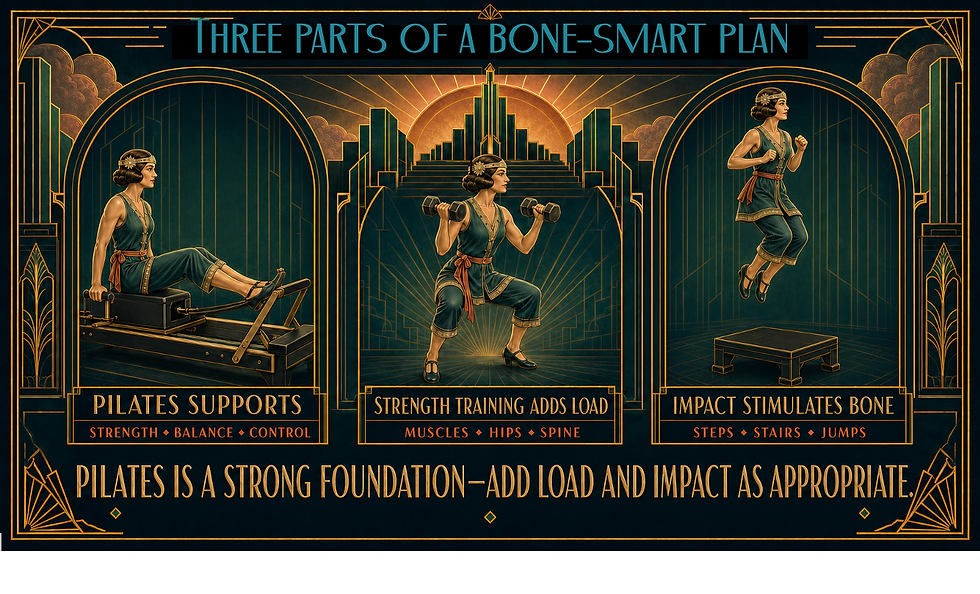
Pilates becomes more bone-focused when the program deliberately progresses resistance, includes upright and weight-bearing positions, develops balance and challenges the body in more than one direction. Reformer, Tower and Chair work can provide scalable loading, while standing work, step-ups, carries, supplemental weights and appropriate impact broaden the stimulus for the hips, spine and whole body.

A bone-smart Pilates approach
The exact program should reflect diagnosis, fracture history, movement experience and confidence. Within that context, a Pilates session can emphasize:
Loaded leg work using progressively challenging springs and ranges.
Hip extension and posterior-chain strength through bridges, hinges and pulling patterns.
Standing and split-stance work that develops leg strength and balance.
Upper-body pushing and pulling through planks, straps, springs or external resistance.
Carries, step-ups and supplemental weights to expand whole-body strength and bone-loading options.
Safe transitions to and from the floor—a practical measure of independence and confidence.
Spinal movement deserves individual consideration
A healthy spine benefits from movement. However, someone with osteoporosis or vertebral fracture risk may need modifications to loaded spinal flexion, forceful twisting or end-range combinations. This is not a blanket instruction to keep the spine rigid. It is a reason to match exercise selection to medical history and work with appropriately qualified professionals.

Questions worth asking
Am I getting stronger in measurable ways?
Does my week include weight-bearing activity?
Is the resistance progressing over time?
Am I practicing balance as well as strength?
Would impact be useful and safe for me?
Do my diagnosis, medications or fracture history require specialized guidance?
A practical weekly framework
There is no single perfect schedule. A useful week distributes challenge and recovery rather than trying to accomplish everything in one session.

Nutrition and medical care matter too
Movement is one part of bone health. Adequate calcium, vitamin D, protein, smoking cessation, moderate alcohol intake and appropriate medical evaluation also matter. Hormone therapy and osteoporosis medications may be recommended for some individuals; those decisions belong in a conversation with a qualified healthcare professional.

Five key takeaways
1 Menopause can accelerate bone loss, but risk and needs vary from person to person.
2 Bone responds to specific demand: progressive resistance, weight-bearing movement and appropriate impact.
3 Pilates can build strength, posture, balance and movement confidence—especially when it is intentionally progressed.
4 Pilates can be paired with progressively heavier resistance and appropriate impact to create a varied, bone-smart movement plan.
5 A diagnosis of osteopenia or osteoporosis calls for thoughtful programming and professional guidance, not automatic avoidance of movement.


Comments